

Introduction
In today’s business environment, growth is often measured through visible outcomes such as revenue, market share, or operational scale. While these indicators are important, they rarely provide a complete picture of an organization’s health. It is entirely possible for a company to perform well financially while experiencing deeper challenges—misaligned leadership, cultural instability, or breakdowns in communication—that quietly limit its long-term potential.
Over time, I began to notice a recurring pattern across organizations of different sizes and industries. When performance felt inconsistent or harder to sustain, the issue was rarely confined to a single function. Instead, it reflected a broader lack of coherence across the business itself.
This is where an organizational alignment framework becomes useful.
Rather than viewing a company as a collection of separate departments, it is more accurate to understand it as a system of interconnected layers, each influencing how decisions are made, how teams collaborate, and how strategy is executed. When alignment is present across these layers, the organization operates with clarity and momentum. When alignment breaks down, friction begins to surface—often in subtle ways at first, but eventually across multiple areas of the business.
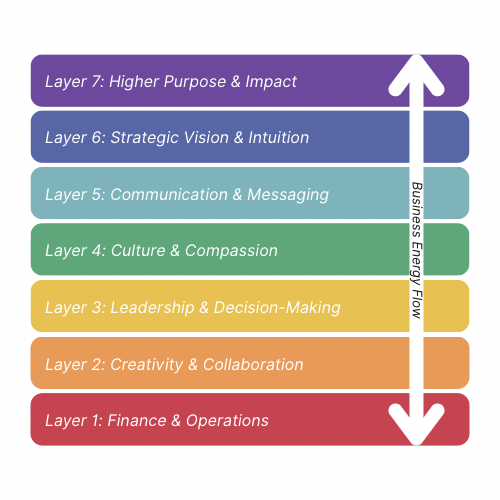
The framework I use to understand these dynamics is what I call the 7 Layers of Organizational Alignment. It offers a structured way to examine how different dimensions of a business—ranging from operations and leadership to culture, communication, and purpose—interact as a unified system.
The intention is not to introduce complexity, but to create clarity. By understanding how alignment moves through an organization, leaders can more effectively identify where challenges originate and how they can be addressed in a more integrated way.
If you want to assess how these layers are functioning in your own organization, you can start with the Oscension diagnostic.
What Is the Organizational Alignment Framework?
At its core, this organizational alignment framework is built on seven distinct yet interconnected layers, each representing a fundamental aspect of how a business functions. While these layers can be examined individually, their true value emerges when they are understood as part of a larger system, where each layer both influences and depends on the others.
This structure provides a practical lens through which leaders can assess not only what is happening within their organization, but also why certain patterns—such as stalled growth, communication breakdowns, or cultural tension—continue to reappear.
The seven layers are outlined below:
Layer 1 — Finance & Operations
This layer forms the structural foundation of the business. Financial stability and operational reliability create the conditions necessary for all other functions to perform effectively. When this layer is strong, the organization benefits from consistency and predictability; when it is unstable, pressure tends to ripple upward into other areas.
Layer 2 — Creativity & Collaboration
This layer governs how ideas are generated, shared, and developed within the organization. It reflects the quality of collaboration between individuals and teams, as well as the organization’s ability to innovate and adapt. A well-functioning layer here supports experimentation and problem-solving, while misalignment can lead to stagnation or fragmented efforts.
Layer 3 — Leadership & Decision-Making
At the center of execution lies leadership and the way decisions are made. This layer determines how clearly priorities are set, how authority is exercised, and how quickly the organization can respond to change. Strong alignment here creates confidence and direction, whereas inconsistency often results in hesitation or confusion.
Layer 4 — Culture & Compassion
This layer represents the relational environment of the organization. It includes trust, psychological safety, and the shared values that shape how people work together. A healthy culture enables sustained performance, while misalignment can manifest as disengagement, burnout, or lack of cohesion.
Layer 5 — Communication & Messaging
Communication connects every part of the organization. This layer reflects how clearly information is shared internally, as well as how effectively the organization expresses itself externally. When aligned, communication creates shared understanding; when misaligned, it introduces distortion and inefficiency.
Layer 6 — Strategic Vision
This layer defines where the organization is going and how it intends to evolve over time. It encompasses long-term direction, adaptability, and the ability to anticipate change. Without clarity at this level, even strong execution in other areas can lose focus.
Layer 7 — Purpose & Impact
At the highest level, this layer connects the organization to its broader meaning and contribution. It shapes why the business exists and how it defines success beyond short-term outcomes. When aligned, it provides cohesion across all other layers.
While each of these layers serves a distinct function, they do not operate independently. Instead, they form a continuous system in which alignment—or misalignment—in one area influences the others. This is what makes the framework particularly valuable: it allows leaders to move beyond isolated problem-solving and toward a more integrated understanding of performance.
Why Alignment Drives Performance
For many leaders, challenges within a business are often approached as isolated issues—an operational inefficiency, a communication gap, or a cultural concern. However, these challenges are rarely independent. More often, they are expressions of deeper structural misalignment within the organization.
For example, when financial pressure increases, it can restrict experimentation and limit collaboration. When culture weakens, communication tends to lose clarity. When communication becomes inconsistent, strategic direction becomes harder to execute. Over time, these effects compound, creating friction that is difficult to resolve through surface-level adjustments.
What this organizational alignment framework provides is a way to recognize these patterns as part of a broader system.
Research across organizational psychology and management consistently supports these relationships. Teams that operate within high-trust environments tend to perform more effectively and innovate more consistently. Clear communication improves decision-making speed and alignment across teams. Organizations with well-defined long-term direction are better positioned to adapt and sustain growth.
These outcomes are not coincidental—they reflect underlying structural coherence.
By viewing the organization through the lens of alignment rather than isolated functions, leaders gain a clearer understanding of how performance is generated. Instead of reacting to symptoms, they are able to identify where misalignment originates and how it moves through the system.
Deep Dive Into Each Layer
Understanding the seven layers conceptually is a useful starting point, but the real value of this organizational alignment framework emerges when each layer is examined more closely. Alignment within a layer is not binary; it exists along a spectrum, where strengths can be reinforced and weaknesses can gradually compound if left unaddressed.
What follows is a more detailed look at how alignment and misalignment tend to manifest within each layer, along with practical considerations for strengthening them.
Layer 1 — Finance & Operations
This layer provides the structural foundation upon which all other layers depend. When financial systems are stable and operations are efficient, the organization gains the consistency required to support growth, experimentation, and long-term planning. In this state, teams are not preoccupied with survival, and leadership can focus on strategic decisions rather than constant course correction.
When misalignment occurs at this level, it often appears as persistent financial pressure, reactive cost-cutting, or operational inefficiencies that consume attention and resources. Over time, this instability can restrict creativity, slow decision-making, and create tension across teams.
Strengthening this layer requires disciplined financial planning, clarity in operational processes, and a shared understanding of how resources are allocated. Transparency, in particular, plays a key role in maintaining alignment, as it enables the organization to respond proactively rather than reactively.
Layer 2 — Creativity & Collaboration
This layer reflects how effectively ideas move through the organization. When aligned, it supports open collaboration, cross-functional thinking, and a steady flow of innovation. Teams are able to build on one another’s contributions, and new ideas are explored with both curiosity and structure.
Misalignment in this layer tends to show up as disengagement, fragmented collaboration, or a noticeable decline in creative output. In some cases, individuals may work in isolation despite being part of a broader team, leading to duplicated efforts or missed opportunities.
To strengthen alignment here, organizations benefit from creating intentional spaces for collaboration, encouraging diverse perspectives, and investing in the interpersonal skills that support effective teamwork. When individuals feel both supported and challenged, the quality of ideas improves naturally.
Layer 3 — Leadership & Decision-Making
Leadership serves as the mechanism through which priorities are translated into action. When this layer is aligned, decisions are made with clarity, consistency, and a clear sense of direction. Authority is understood, and the organization moves forward with confidence.
Misalignment often appears as hesitation, conflicting priorities, or an overconcentration of decision-making authority in too few individuals. In these situations, teams may wait for direction rather than act independently, slowing overall momentum.
Improving alignment within this layer involves clarifying decision-making structures, developing leadership capability across the organization, and creating systems that support timely and well-informed decisions. Effective leadership is not only about direction, but also about enabling others to act with confidence.
Layer 4 — Culture & Compassion
Culture represents the emotional and relational environment of the organization. When aligned, it fosters trust, respect, and a shared sense of responsibility, allowing individuals to perform at their best over sustained periods of time. A strong culture does not eliminate challenges, but it creates the conditions in which challenges can be addressed constructively.
Misalignment in this layer often manifests as disengagement, burnout, or a lack of trust between individuals and teams. These conditions can quietly erode performance, even when other parts of the organization appear to be functioning well.
Strengthening this layer requires consistent attention to how people experience the organization. Initiatives such as feedback systems, team development, and leadership modeling all contribute to a culture that supports both performance and well-being.
Research such as Google’s Project Aristotle highlights the importance of psychological safety in high-performing teams.
Layer 5 — Communication & Messaging
Communication is the connective tissue of the organization. It determines how effectively information flows between teams, how clearly strategy is understood, and how the organization presents itself externally.
When this layer is aligned, communication is both clear and consistent. Teams share a common understanding of priorities, and external messaging reflects the organization’s identity and direction.
Misalignment, by contrast, introduces distortion. Messages become inconsistent, information is lost between functions, and misunderstandings increase. Over time, this lack of clarity can undermine both internal execution and external perception.
Improving alignment in communication involves establishing clear channels, reinforcing shared language, and ensuring that messaging reflects the organization’s strategy and values. Consistency, more than volume, is what creates clarity.
Layer 6 — Strategic Vision & Intuition
This layer defines how the organization understands its future. When aligned, it provides direction, focus, and the ability to adapt as conditions change. A clear strategic vision enables teams to prioritize effectively and align their efforts with long-term objectives.
Misalignment at this level often appears as short-term thinking, shifting priorities, or a lack of cohesion between initiatives. Even with strong execution, the absence of a clear direction can lead to fragmented progress.
Strengthening this layer involves structured planning, regular reflection on external trends, and the willingness to adjust course when necessary. A strong vision is not static; it evolves as the organization learns.
Long-term strategic alignment has been widely studied, including research from McKinsey on organizational health and performance.
Layer 7 — Purpose & Impact
At the highest level, this layer connects the organization to its broader meaning and contribution. When aligned, purpose provides coherence across all other layers, guiding decisions and shaping the organization’s identity.
Misalignment can manifest as a disconnect between stated values and actual behavior, or as a focus on short-term outcomes at the expense of long-term impact. In these cases, the organization may still function, but it lacks a unifying direction.
Strengthening alignment here requires clarity of intent and consistency in action. Purpose becomes meaningful when it is reflected not only in messaging, but in decisions, priorities, and outcomes.
The Flow of Alignment
Understanding each layer individually is important, but the true strength of this organizational alignment framework lies in how these layers interact as a system.
Alignment does not move in a single direction. Instead, it flows both upward and downward, creating a dynamic relationship between structure, execution, and meaning.
From a foundational perspective, alignment often begins with stability. When financial and operational systems are strong, they create the conditions for collaboration and innovation. This, in turn, supports effective leadership, which reinforces culture, enables clear communication, and ultimately contributes to strategic clarity and purpose.
At the same time, alignment can also originate from the top. A clearly defined purpose shapes strategic direction, which influences how communication is structured, how culture evolves, and how leadership operates. This influence continues downward, affecting collaboration and, ultimately, operational performance.
These two directions are not in opposition. Rather, they form a continuous cycle.
When alignment is present, this cycle becomes self-reinforcing. Improvements in one layer support progress in others, creating momentum across the organization. When misalignment occurs, however, the opposite effect can take place, where challenges in one area begin to spread and compound over time.
Recognizing this flow allows leaders to move beyond isolated interventions and instead focus on restoring coherence across the system as a whole.
Measuring and Managing Alignment
For any organizational alignment framework to be effective, it must connect insight to measurement. While alignment can be experienced qualitatively, it can also be observed through specific indicators that reflect how each layer is functioning.
For example, financial stability and operational efficiency can be evaluated through metrics such as revenue growth, margin performance, and turnover rates. Collaboration and creativity may be reflected in employee engagement, the number of new initiatives, or investment in innovation. Leadership effectiveness can be assessed through decision-making speed, clarity of priorities, and leadership development outcomes.
Similarly, cultural alignment can be understood through engagement scores and retention patterns, while communication effectiveness can be evaluated through clarity assessments and customer feedback. Strategic alignment may be reflected in the organization’s ability to execute long-term initiatives, and purpose can be observed through stakeholder trust and broader impact measures. Many organizations use structured diagnostics to regularly assess alignment across teams and functions.
The objective is not to create an overwhelming set of metrics, but to develop a balanced view of how the organization is functioning as a system.
Regular review cycles—whether quarterly assessments, leadership discussions, or employee feedback processes—help ensure that alignment is maintained over time. By consistently observing these indicators, organizations can identify areas of friction early and address them before they begin to spread.
Employee engagement and organizational effectiveness metrics are well documented in studies by Gallup. In this way, measurement becomes not just a tool for evaluation, but a mechanism for continuous alignment.
Aligning the System for Sustainable Growth
When I step back and look across the seven layers, one pattern becomes consistently clear: growth without alignment is inherently unstable.
An organization may achieve short-term success through strong execution in a single area—whether that is financial performance, product innovation, or strategic positioning—but without coherence across the broader system, that success becomes difficult to sustain. Over time, misalignment begins to surface in more subtle ways: decisions slow, communication fragments, culture weakens, and momentum becomes harder to maintain.
What makes this organizational alignment framework valuable is not simply that it categorizes different aspects of a business, but that it reveals how those aspects interact. It provides a structured way to understand why challenges rarely exist in isolation and why addressing symptoms without addressing underlying alignment often leads to repeated cycles of friction.
In practice, this means that improving performance is not only about optimizing individual functions, but about strengthening the connections between them. Financial stability supports innovation. Innovation informs leadership decisions. Leadership shapes culture. Culture enables communication. Communication reinforces strategy. Strategy aligns with purpose. And purpose, in turn, influences how every other layer operates.
When these relationships are aligned, the organization begins to function with a different quality—one characterized by clarity, adaptability, and sustained momentum. Effort becomes more effective, decisions become more coherent, and growth becomes more consistent.
At the same time, the goal is not to achieve perfect alignment across all layers at all times. Organizations are dynamic, and periods of imbalance are inevitable. The value of this framework lies in providing a clear reference point—a way to identify where alignment is strongest, where it is beginning to break down, and how those dynamics are evolving over time.
This raises an important question for any leader:
Where is alignment currently strongest in your organization, and where is it beginning to weaken?
In many cases, the answer is not immediately obvious. What appears to be a communication issue may originate in strategy. What feels like a cultural challenge may stem from leadership or operational pressure. Without a structured way to assess these relationships, it becomes difficult to see how these patterns connect.
This is precisely where a diagnostic approach becomes valuable.
If you want to better understand how these layers are functioning within your organization, you can begin with the Oscension Alignment Diagnostic. It provides a structured way to assess alignment across all seven layers and identify where friction is occurring.
The intention is not to prescribe a single solution, but to offer visibility—because once alignment can be seen, it can be improved.
Ultimately, organizations that learn to operate in this way—treating alignment as an ongoing discipline rather than a one-time initiative—are better positioned to adapt, evolve, and grow with consistency over time.
That is the essence of sustainable performance: not just growth, but growth that is supported by a system capable of sustaining it.