

In the early 2000s, LEGO® looked timeless from the outside and tangled on the inside.
Revenue dropped. Costs climbed. Product lines sprawled. The company famous for simple, structured creativity drifted into a maze of theme parks, video games, apparel, media ventures, and thousands of hyper-specialized bricks. The brand still sparkled; the system behind it creaked.
Yet this story did not end in a quiet acquisition or a slow fade into nostalgia. It turned into one of the most instructive modern corporate comebacks.
The LEGO turnaround strategy did not hinge on a single miracle product or a clever marketing campaign. It rested on something less glamorous and far more demanding: alignment.
Leadership chose to strengthen the structure before chasing speed.
As I study this LEGO turnaround case study through the Oscension lens—treating organizations as living systems—I see a simple but powerful truth:
Growth does not start with acceleration.
Growth starts with sequence.
When a business tries to move faster than its structure allows, every new initiative multiplies friction. Misalignment hides for a while, then it surfaces as burnout, inconsistency, and financial drag. LEGO reached that point. The way back offers a useful map.
When Expansion Outruns Structure
Before the crisis, LEGO leaned hard into expansion.
The company pushed into:
- Theme parks and physical experiences
- Licensed media and character tie-ins
- Video games, films, and TV
- Apparel and lifestyle products
- Highly specialized sets with unique, one-off elements
On a slide deck, this LEGO business strategy looked bold and visionary. In the real system, it created instability.
The number of unique brick molds exploded. Inventory became harder to manage. Manufacturing struggled to handle the variety. Financial performance grew harder to stabilize and harder to read. Creativity no longer flowed inside a clear system; it spilled over the edges.
I see this pattern often. Leaders hit a plateau and instinctively decide to “do more”:
- More offers
- More channels
- More markets
- More tools
The internal architecture cannot carry that extra energy, but the pressure to grow feels urgent, so the organization spreads itself thinner instead of aligning itself better.
At LEGO, creativity drifted away from the core system. Product development moved faster than operations and finance. Leadership spread bets across many disconnected directions. The brand still held emotional power, but the business behind it started to crack.
Ancient wisdom offers a simple phrase for this: as within, so without. Internal fragmentation eventually shows up as external crisis. LEGO did not suffer from a lack of ideas; it suffered from a lack of coherence.
The turnaround began when leadership stopped asking, “What else can we be?” and started asking, “What must this system become to hold itself together?”

Alignment Before Acceleration
If you strip this story down to its essence, you run into one question that sits at the core of any real turnaround:
Can this system carry more energy without tearing itself apart?
Alignment answers that question.
I don’t use “alignment” as a soft, feel-good notion. I use it in a structural way: coherence between the layers of a business—how money flows, how ideas move, how decisions form, how people relate, how the story lands, how the future comes into focus, and why the organization exists.
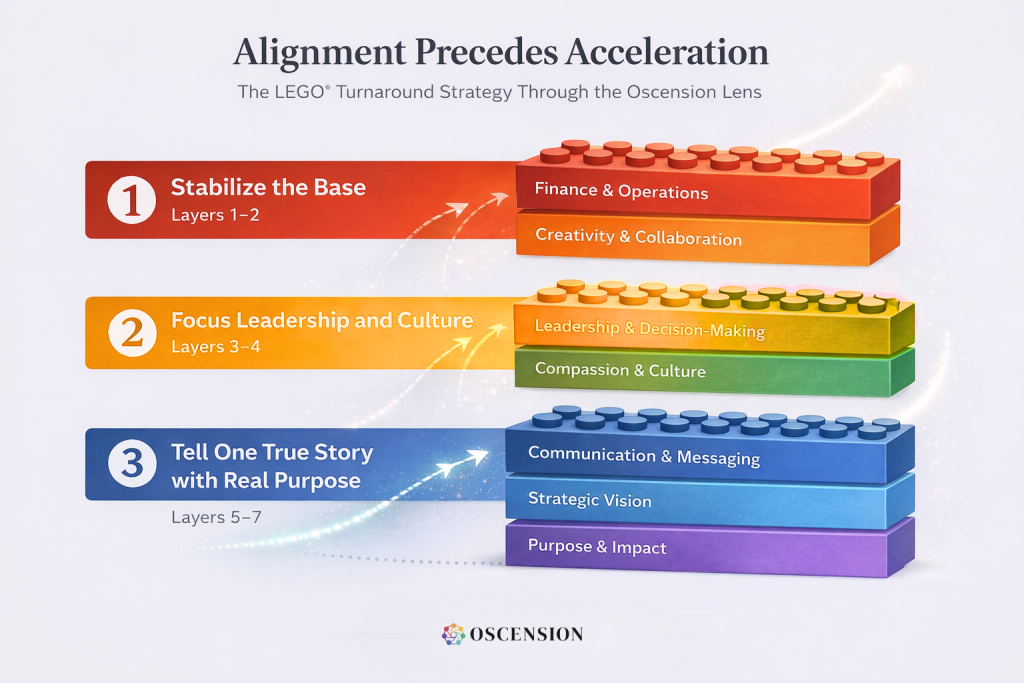
In Oscension, I map that coherence across seven layers:
- Finance & Operations
- Creativity & Collaboration
- Leadership & Decision-Making
- Compassion & Culture
- Communication & Messaging
- Strategic Vision
- Purpose & Impact
These layers describe how energy moves through a company, from the most concrete (cash flow, systems, logistics) to the most subtle (meaning, contribution, long-term direction).
If you want to see where your own business might be misaligned, you can take the Oscension Alignment Quiz.
LEGO’s crisis came from misalignment across these layers:
- Operations strained under product sprawl.
- Creative teams designed in ways that ignored cost and complexity.
- Leaders pursued too many bets.
- Culture absorbed the confusion.
- Brand expression scattered.
- Strategy blurred.
- Purpose lost its grip on everyday decisions.
The LEGO turnaround strategy did not try to fix this with motivational language. Leadership changed the sequence of transformation. Instead of pushing for growth and hoping alignment would follow, they realigned the system and let acceleration emerge as a side-effect.
I often use a simple phrase with founders and executives:
Alignment isn’t mystical — it’s measurable.
You see it in SKU counts and margins, in decision clarity, in the level of rework, in how consistently the story matches reality, and in whether purpose shapes trade-offs or just decorates the website.
LEGO chose to treat alignment as a hard constraint, not a soft aspiration. That choice changed everything.
The Turnaround in Three Movements
The detailed version of this story runs layer by layer, but you can hold the essence in three movements: stabilize the base, focus the middle, clarify the top.
1. Stabilize the Base (Layers 1–2)
The first movement anchored itself in the ground: Finance & Operations and Creativity & Collaboration.
LEGO:
- Slashed the number of active elements.
- Standardized more parts.
- Sold or scaled back non-core assets.
- Tightened manufacturing and inventory practices.
The company made stability non-negotiable. Cash flow, margins, and operational reliability started to improve because the system carried less unnecessary complexity.
Then leadership turned to creativity—not to reduce it, but to discipline it.
Designers learned the operational and financial impact of their choices. They favored reusable, modular elements over one-off pieces. Cross-functional collaboration strengthened between design, operations, and finance. Creative energy moved inside the system instead of floating above it.
The transformation can be described as a process that rises from the root. A tree doesn’t start with branches; it starts with roots and trunk. LEGO followed that logic: strengthen the root (Layer 1), then align the creative flow (Layer 2).
2. Focus Leadership and Culture (Layers 3–4)
With the base stabilizing, the second movement focused on Leadership & Decision-Making and Compassion & Culture.
Before the crisis, leadership scattered energy across many directions: parks, media ventures, side categories, experimental products. During the turnaround, leaders chose fewer, clearer bets and recentered the business around the core brick system.
They concentrated decision authority instead of diffusing it. They treated “no” as a strategic act, not a personal failure. The LEGO turnaround strategy started to look less like a rescue mission and more like a series of clean, structural choices.
Culture felt the difference.
When an organization constantly shifts direction, people lose trust in strategy and in leadership promises. As LEGO simplified and clarified, teams gained a clearer sense of:
- What mattered
- What no longer belonged
- How their work contributed to a coherent whole
Compassion in this context did not mean avoiding hard calls. It meant making hard calls in service of a healthier system. Culture gained relief because structure stopped contradicting the story.
3. Tell One True Story with Real Purpose (Layers 5–7)
The third movement rose through Communication & Messaging, Strategic Vision, and Purpose & Impact.
Externally, LEGO sharpened its narrative:
- The brick returned to the center of the story.
- Product lines grouped into clearer families and themes.
- The brand spoke more about a modular system of play than about sheer variety.
Strategy also shifted. Instead of “expand everywhere,” LEGO focused on deepening the core system. Partnerships and licenses made sense when they sat on top of the brick ecosystem, not when they pulled the company away from it.
Finally, purpose reasserted itself: inspiring and developing builders of tomorrow. That purpose started to behave like a guardrail:
- If an initiative diluted the building experience, it lost priority.
- If a venture stretched the brand beyond what the system could hold, leadership let it go.
In Oscension terms, the top-down flow (purpose → vision → story) finally met the bottom-up flow (operations → creativity → leadership). The middle layers—culture and decision-making—became the crossing point.
At that moment, the system could finally carry its own acceleration.
What Most Turnarounds Miss
Most companies do not fail because leaders lack intelligence or care. They fail because leaders apply their intelligence in the wrong order.
I see a few common patterns.
The “Cut and Pray” Response
Some executive teams respond to crisis with blunt cuts:
- Layoffs
- Budget freezes
- Cancelled projects
Cost control matters, but if you cut without a model of how the layers interact, you can:
- Strip away critical capabilities
- Damage trust
- Create short-term relief and long-term fragility
You save money but lose muscle.
The Cosmetic Rebrand
Others respond by changing the story instead of changing the structure:
- New logo
- New tagline
- New campaign
Inside, nothing important changes. Culture still feels confused. Operations still strain. Decisions still scatter. In Oscension language, Layer 5 spins while Layers 1–4 stay stuck.
The signal gets louder; the song stays off-key.
The “More Initiatives” Trap
Another familiar response: add more.
- New products
- New markets
- New tools
- New internal programs
Leaders feel pressure to show action, so they equate motion with progress. Every new initiative lands on top of an already misaligned system. Energy spreads thinner. People feel busier and less effective.
The mistake in each case comes down to sequencing.
Leaders pull on vision, brand, or purpose while the foundation still wobbles. The LEGO transformation strategy corrected that mistake. It changed the order:
- Stabilize the foundation.
- Discipline creativity.
- Concentrate decisions.
- Reduce cultural friction.
- Clarify the story.
- Use vision as a filter.
- Let purpose shape trade-offs.
That sequence turned a vulnerable brand into a resilient system.
A Short Self-Diagnostic: Your “LEGO Moment”
You don’t need a full crisis to borrow this wisdom. You can run a simple scan across your own business and notice where alignment slips.
Ask yourself:
Foundation – Finance & Operations
- Do I actually trust my numbers?
- Do my systems feel simple enough that more growth would excite me, not scare me?
Creativity & Collaboration
- Do my creative or technical teams understand constraints, or do they design in a vacuum?
- Do key functions collaborate early, or only when something breaks?
Leadership & Culture
- Do people know who decides what?
- Do my decisions build trust, or do they generate quiet confusion?
Story, Vision, Purpose
- Does my external story match the internal experience of my team?
- Does my strategy eliminate options as clearly as it creates them?
- Does my purpose cost me anything, or does it just sound good?
If these questions stir discomfort, you might stand where LEGO once stood—before the turnaround, not after it. That realization does not signal failure; it signals opportunity.
You can choose the same principle LEGO embodied:
Align first.
Accelerate second.
You don’t need to copy LEGO’s exact moves. You only need to respect the order. Each simplification, each clear “no,” each honest conversation about structure becomes a quiet investment in your future speed.
So I leave you with this:
If your revenue tripled in the next year, would your current architecture hold that energy—or crack under it?
If the answer feels shaky, you just found your LEGO moment. The next move does not require urgency. It requires sequence.
Further Reading: